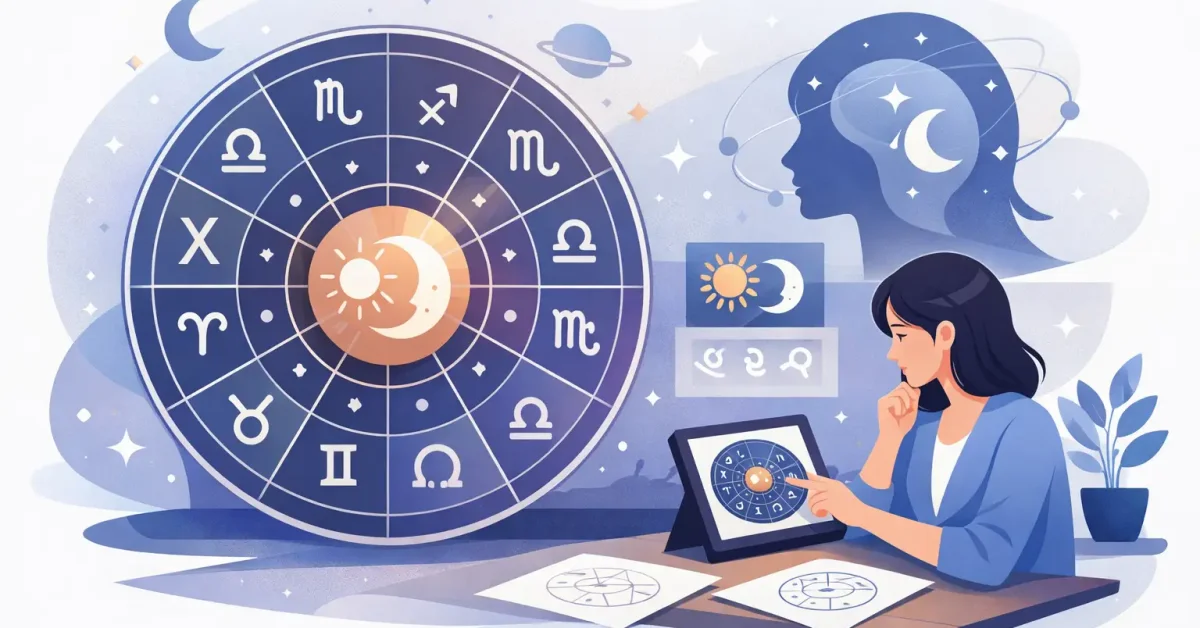
A birth chart can feel strangely intimate the first time you see it. There is your name, your birth date, your exact moment under the sky - and then a wheel full of symbols that seems to know more about your patterns than a generic horoscope ever could. A good free natal chart interpretation should make that complexity readable, not flatten it into fortune-cookie language.
What a free natal chart interpretation should actually tell you
The best starting point is simple: your chart is a map of tendencies, not a verdict. It shows how you process emotion, pursue goals, relate to other people, and meet change. It can point to strengths you already trust, tensions you keep repeating, and life areas that ask for more conscious attention.
That matters because many free chart readings stop too early. They tell you that your Sun sign shapes identity, your Moon sign shapes emotions, and your Rising sign shapes first impressions. All true. But if the interpretation ends there, it misses the structure that gives those placements meaning.
A more useful reading connects planets to houses and aspects. In other words, it asks not only what a placement is, but where it shows up in life and how it interacts with the rest of the chart. A Venus in Capricorn means one thing in theory. Venus in Capricorn in the 7th house, squared by Saturn, tells a much more specific story about love, commitment, standards, and emotional pacing.
How to read a free natal chart interpretation without getting lost
If you pull up your chart and feel overwhelmed, start with hierarchy. Not every symbol carries the same weight right away. Some placements describe your basic style. Others add nuance later.
Begin with your big three
The Sun, Moon, and Rising are still the clearest entry point. The Sun speaks to identity and the kind of vitality you are building over time. The Moon shows emotional habits, needs, and instinctive reactions. The Rising sign sets the tone of the chart - how you approach life, how others read you, and which houses fall where.
This is why two people with the same Sun sign can seem nothing alike. If one has a Cancer Sun with an Aries Moon and Scorpio Rising, and another has a Cancer Sun with a Libra Moon and Gemini Rising, the emotional rhythm, social style, and life emphasis shift dramatically.
Then look at the chart ruler
The chart ruler is the planet that rules your Rising sign. It often acts like a backstage director, telling you how the whole chart tends to operate. If you are Virgo Rising, Mercury becomes especially important. If you are Scorpio Rising, Mars and, in modern astrology, Pluto deserve close attention.
Its sign, house, and aspects matter. A Sagittarius Rising with Jupiter in the 10th house often channels growth through public ambition, recognition, or visible achievement. The same Rising sign with Jupiter in the 4th may grow through family roots, home life, or inner stability first.
Use the houses to ground the reading
Houses are where astrology becomes practical. They map the chart onto actual life areas - identity, money, communication, home, romance, work, partnership, shared resources, belief, career, community, and the private inner world.
Without houses, a reading can sound elegant but vague. With houses, it starts to answer real questions. Is that Mars energy showing up in career competition, in family conflict, in creative risk, or in one-on-one relationships? The house tells you where the heat tends to rise.
Why free natal chart interpretation varies so much in quality
Some free tools are surprisingly insightful. Others are little more than keyword piles. The difference usually comes down to synthesis.
Astrology is not just a list of placements. It is a pattern language. A chart with strong water signs, a 12th-house Moon, and Neptune aspects needs a different interpretive tone than a chart dominated by fire, cardinal energy, and angular Mars placements. If each feature is described separately with no attempt to connect them, the result feels fragmented.
There is also the issue of contradiction. Most charts contain it. You might have a bold Leo Sun and a cautious Capricorn Moon. You might crave closeness while guarding your vulnerability. You might be socially charming and privately severe with yourself. A credible reading does not erase those tensions. It explains how both can be true.
That is often where astrology becomes useful rather than decorative. It reflects the mixed signals people already feel in themselves and gives them structure.
The placements that usually deserve a closer look
After the basics, a few chart features tend to carry outsized meaning.
Moon, Saturn, and relationship patterns
If you want emotional clarity, start with the Moon. If you want to understand why intimacy sometimes feels easy and sometimes feels loaded, add Saturn and Venus. Saturn does not always mean difficulty, but it does point to pressure, maturity, delay, or the need to build trust slowly.
A free natal chart interpretation that mentions Venus without mentioning Saturn aspects may miss the deeper reason someone approaches love carefully. Likewise, a chart with strong Moon-Pluto aspects can suggest emotional intensity that a softer description would never capture.
Mars and how you go after what you want
Mars is not just about anger. It speaks to appetite, drive, stamina, and the way you assert yourself. In work, it can show how you compete. In dating, it can reveal how direct or indirect your pursuit style is. In everyday life, it often describes your response to friction.
Mars in Libra is not weak. It is strategic. Mars in Pisces is not passive by default. It can act through intuition, timing, and emotional sensitivity. This is where nuance matters. Sign stereotypes are rarely enough.
The 10th house and public direction
When people ask astrology about career, they often look only at the Midheaven or 10th house sign. That helps, but it is not the whole story. The ruler of the 10th, planets placed there, the 6th house of daily work, and Saturn all contribute.
A person can have a creative Midheaven and still prefer stable, structured work if Saturn is dominant. Another might have a practical career axis but build a public role around beauty, design, or relationship work because Venus is highly emphasized. A chart describes the style and motive beneath success, not just the job title.
What free interpretations can do well - and where they stop
Free astrology has real value when it offers orientation. It can show you your core placements, explain major themes, and help you ask better questions about yourself. For many people, that first encounter is enough to make the chart feel alive.
But there are limits. Automated readings tend to struggle with timing, priority, and context. They may tell you that you are imaginative, disciplined, romantic, and independent all at once without clarifying which themes dominate or when each one comes forward.
This matters even more with transits. A natal chart shows your baseline pattern. Transits show what is being activated now. Someone in a Saturn transit to the Moon will experience their chart differently than they did a year earlier. The same birth chart can feel softer, heavier, more relational, or more career-focused depending on what the sky is doing in the present.
That is why the most useful astrology is ongoing, not static. Your stars, decoded, should still reflect timing.
How to get more value from your chart right away
Treat your reading as a conversation, not a verdict. Notice what lands immediately and what feels premature. Some placements make sense at once. Others become clear only after a breakup, a job change, a move, or a period of inner pressure.
It also helps to focus on one life area at a time. If you are looking for relationship insight, prioritize the 7th house, Venus, Moon, Mars, and relevant aspects. If you are looking at career, start with the 10th house, 6th house, Saturn, Sun, and chart ruler. The chart is whole, but your questions can still be specific.
And be careful with fatalistic interpretations. Astrology is descriptive, not sentencing. A difficult aspect may describe effort, not doom. An easy trine may show natural talent, but talent still needs direction. The chart shows weather patterns. You are still the one living the day.
Free natal chart interpretation is most powerful when it feels personal
A chart reading becomes memorable when it names something precise: the reason you need both freedom and reassurance, the pattern behind overthinking in relationships, the pull between privacy and visibility, the way ambition and sensitivity keep trading places. Precision is what makes astrology feel less like content and more like recognition.
That is also why a polished platform matters. Clean structure, readable language, and accurate chart logic make a difference. Stellar Omens approaches astrology the way many people actually use it now - not as abstract symbolism floating above life, but as a practical system for understanding timing, relationships, work, and self-trust.
If your chart feels complicated, that is not a flaw in the reading. It is usually a sign that you are finally looking beyond the sun-sign surface. Stay with the parts that feel specific. Let the chart reveal itself in layers. The most useful insight is rarely the loudest line on the page. It is the one that quietly explains you back to yourself.