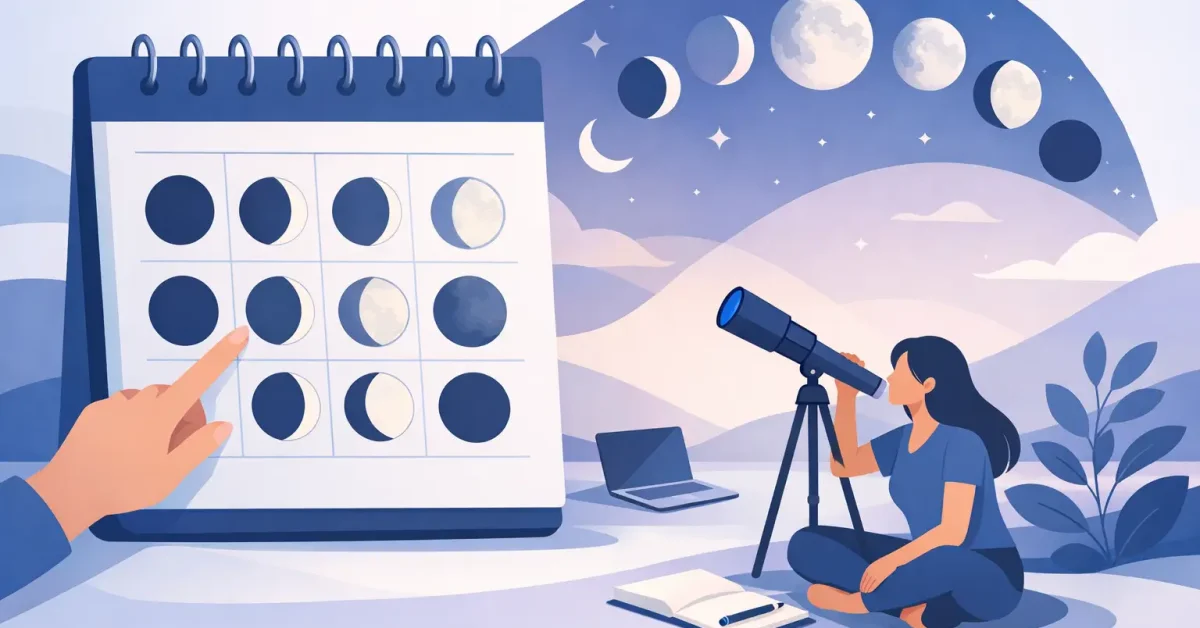
Some months feel like they arrive with a clear rhythm. Others seem to scatter your focus, stir your emotions, or push decisions before you feel ready. A monthly moon phase calendar gives that rhythm a shape. Instead of treating the lunar cycle as background atmosphere, you can use it as a practical timing tool for reflection, planning, relationships, and momentum.
For astrology-minded people, this is where the moon becomes more than a pretty symbol on an app screen. The moon describes pacing. It shows when energy is building, when something is peaking, and when it is wiser to release than to force. A good calendar helps you see those shifts at a glance, then translate them into everyday life.
What a monthly moon phase calendar actually shows
At its simplest, a monthly moon phase calendar maps the moon's changing shape across the month. You will usually see the four major phases - new moon, first quarter, full moon, and last quarter - along with the waxing and waning crescent and gibbous phases in between.
That basic version is useful on its own. It tells you whether the lunar cycle is beginning, growing, climaxing, or winding down. But the most useful calendars often include more context, such as the zodiac sign of each lunation, the exact date and time of major phases, and sometimes eclipses or notable aspects involving the moon.
This matters because not every full moon feels the same. A full moon in Virgo has a different tone from a full moon in Sagittarius. One may spotlight systems, health, and work. Another may widen the lens and bring truth, travel, beliefs, or big-picture questions to the surface. The calendar gives you the timing. Astrology gives you the texture.
Why the lunar cycle is worth tracking monthly
The appeal of a monthly moon phase calendar is not just spiritual atmosphere. It is pattern recognition. When you track the moon over several months, you begin to notice that certain phases support certain kinds of choices better than others.
New moons tend to favor intention-setting, fresh starts, and quieter planning. That does not mean every new moon is the perfect day to launch something. Sometimes the energy is fertile but inward. Sometimes other transits complicate the picture. Still, the new moon is often a clean reset point.
As the moon waxes, energy gathers. First quarter phases often coincide with friction, action, or the need to make a decision. This is where ideas meet reality. If a plan is viable, it usually asks for effort here.
The full moon brings visibility. Emotions rise, information surfaces, and unfinished dynamics can no longer stay in the background. For some people, full moons feel energizing. For others, they feel overstimulating. Either way, they tend to reveal what has ripened.
The waning half of the cycle is quieter but just as important. Last quarter moons often support editing, releasing, and rethinking. If you only use the moon for manifestation language, you miss half the cycle. Closure is timing too.
How to read a monthly moon phase calendar in a useful way
The easiest mistake is to read the calendar as decoration rather than instruction. If you want it to be useful, start with the four anchor points of the cycle and relate them to real life areas.
Look first at the new moon. Ask what is beginning, what deserves a fresh approach, and which part of your life is asking for conscious attention. If you know the zodiac sign of the new moon, that gives you a clue about the theme. If you know your birth chart, even better - you can identify the house being activated, which shows the life area most directly involved.
Then look at the full moon roughly two weeks later. This is often the point of culmination, clarity, or emotional truth. What began to form at the new moon may become visible now. Not always in a neat way, but usually in a revealing one.
The quarter moons are subtler, yet they often describe the moments when life asks for adjustment. First quarter moons can bring tension that pushes movement. Last quarter moons can bring the realization that a certain habit, commitment, or mindset has reached its limit.
Used this way, the calendar stops being abstract. It becomes a monthly framework for timing decisions, conversations, creative work, rest, and review.
A monthly moon phase calendar is better with your birth chart
General lunar timing is helpful, but personal astrology adds precision. The moon is not moving through an empty sky. It is moving through your chart.
If a new moon falls in your seventh house, relationship themes may take center stage. If a full moon lights up your second and eighth house axis, money, security, debt, or self-worth may become more emotionally charged. The same lunar event can land very differently from one person to another.
This is the real distinction between casual moon content and useful astrological guidance. A calendar tells you when. Your chart tells you where. Interpretation tells you how that timing may show up in lived experience.
That does not mean you need advanced astrological knowledge to begin. Even a simple awareness of the moon's sign and phase can sharpen your timing. But if you already know your rising sign or use chart-based tools, the monthly calendar becomes far more specific.
What each moon phase is best for
A monthly moon phase calendar becomes most practical when you match each phase to a kind of action.
The new moon is well suited for setting intentions, sketching plans, and beginning softly. It is less about forcing instant results and more about aligning with a new direction.
The waxing moon supports building. This is often a strong time for outreach, development, consistency, and visible effort. Momentum grows here, but it usually needs participation.
The full moon favors awareness. If something needs honest acknowledgment, this is the phase that tends to bring it forward. It can be excellent for celebration, completion, and emotional truth, though not always for calm objectivity.
The waning moon supports refinement and release. This is the phase for cutting excess, finishing loose ends, and stepping back from what no longer fits. If the waxing half says yes, the waning half asks, to what cost and for how long?
There is nuance here. Not every person feels energized by the same phase, and not every month unfolds cleanly. A lunar calendar is a guide, not a command. It works best when paired with self-observation.
How to build a monthly rhythm around the moon
You do not need an elaborate ritual practice to work with lunar timing. In fact, the most sustainable use of a monthly moon phase calendar is often simple.
At the start of each month, note the dates of the new moon, full moon, and quarter phases. Then connect them to your actual schedule. If a full moon lands near a major conversation, launch, or travel date, expect emotions and visibility to run higher. If a new moon arrives during a quieter week, that may be a good time to reset priorities.
A short check-in at each major phase is enough. Around the new moon, ask what you want to begin. Around the first quarter, ask what action is required. Around the full moon, ask what is now clear. Around the last quarter, ask what can be released.
This works especially well for people who want astrology to feel grounded rather than performative. The moon does not require ceremony to be meaningful. Attention is often enough.
Choosing the right monthly moon phase calendar
Not every calendar serves the same purpose. Some are purely visual. Some focus on astronomy. Some are built for astrology and include sign changes, lunations, eclipses, and planetary context.
The right choice depends on how you use it. If you simply want to track the rhythm of the month, a basic phase calendar may be enough. If you want timing guidance for relationships, career moves, emotional patterns, or personal growth, you will want more interpretive detail.
This is where a platform like Stellar Omens can be especially useful. The calendar itself is only the first layer. The deeper value comes from translating lunar timing through your chart, so the month feels less generic and more personally legible.
When moon calendars help most
A monthly moon phase calendar is especially helpful during transition periods. If your routines feel unstable, your emotions are louder than usual, or you are trying to make better timing decisions, the lunar cycle offers structure without rigidity.
It can also help when you are trying to distinguish between a passing mood and a meaningful pattern. If the same themes keep surfacing around similar phases month after month, that is information worth keeping. Astrology is often less about prediction than recognition.
Some people use moon calendars for manifestation. Others use them for emotional awareness, creative pacing, or relationship reflection. All of those are valid, as long as the calendar is being used to support attention rather than replace judgment.
The moon will not make your decisions for you. What it can do is reveal timing, mood, and pressure points with surprising consistency. Month by month, that kind of clarity adds up. And once you start noticing the pattern, it becomes much easier to move with the cycle instead of against it.