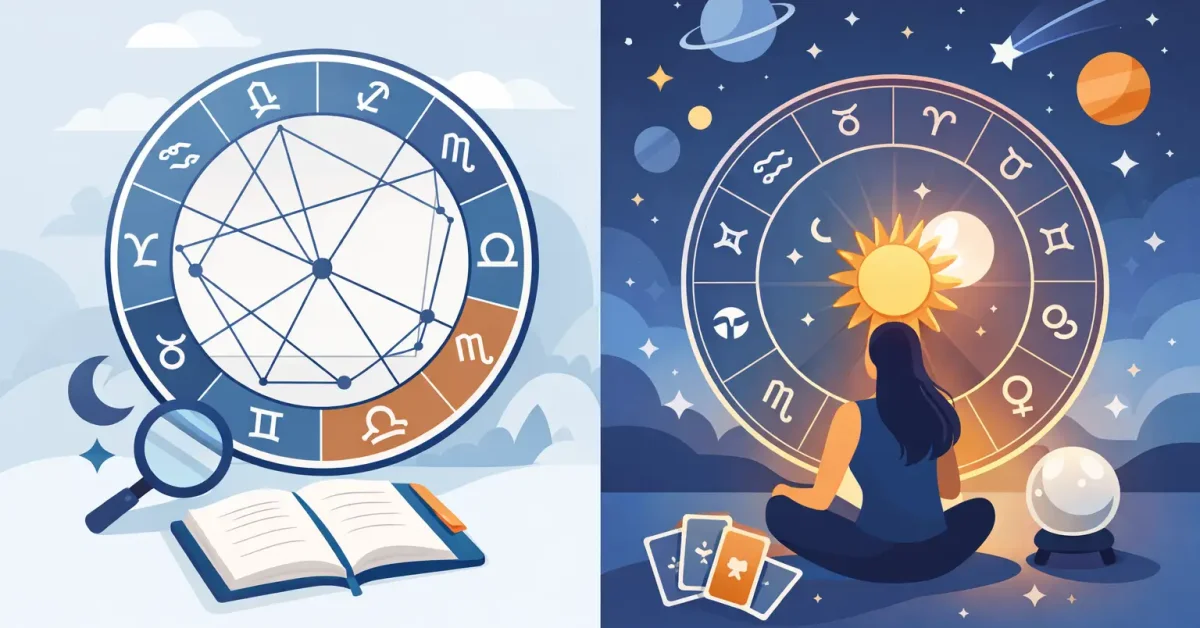
You can read your daily horoscope in 30 seconds and still feel seen. Then you open your birth chart and suddenly astrology gets much more specific - houses, aspects, rising sign, timing, life themes. That gap is exactly what people mean when they ask about natal chart vs horoscope. Both belong to astrology, but they answer very different kinds of questions.
A horoscope is usually a sign-based forecast. It tells you what current planetary movements may mean for a group of people who share the same Sun sign, or sometimes rising sign. A natal chart is your personal astrological blueprint, calculated from your exact birth date, birth time, and birthplace. One is broad guidance. The other is a map built around you.
Natal chart vs horoscope: the core difference
The simplest way to understand natal chart vs horoscope is this: a natal chart describes your cosmic pattern, while a horoscope interprets timing.
Your natal chart is fixed. It captures the sky at the moment you were born and shows where the planets were, which houses they occupied, and how they related to one another through aspects. That structure forms the foundation of your astrological profile. It can speak to temperament, emotional style, communication patterns, relationship needs, career tendencies, and recurring life lessons.
A horoscope is dynamic. It tracks what the planets are doing now and translates those movements into a forecast. Depending on how it is written, it may focus on your Sun sign, rising sign, or your full chart. The broadest horoscopes are general and sign-based. The more precise versions compare current transits to your natal chart and tell you how this moment may land in your actual life.
That distinction matters because astrology has two jobs. First, it describes who you are. Second, it helps with when. Natal charts handle the first job best. Horoscopes are built for the second.
What a natal chart is actually for
People often assume a birth chart is just a more complicated horoscope. It is not. A natal chart is not a forecast at all, at least not by itself. It is the reference system that makes astrology personal.
Your Sun sign may describe your core identity, but your Moon sign speaks to emotional needs, your rising sign shapes how you move through the world, and your house placements show where different life stories tend to play out. Venus can add texture to love and attraction. Saturn can point to effort, pressure, and long-term growth. The chart becomes useful because it turns astrology from general symbolism into lived context.
If two people are both Leos, a generic Leo horoscope gives them the same headline. But their natal charts can look completely different. One Leo may have a Capricorn Moon and Virgo rising, making them measured, private, and strategic. Another may have a Sagittarius Moon and Aries rising, making them bolder, faster, and more impulsive. Same Sun sign, different wiring.
This is why natal chart interpretation tends to feel more accurate. It accounts for complexity instead of flattening it.
What a horoscope is actually for
A horoscope is best understood as a time-sensitive reading. It translates current planetary weather into guidance. That can be emotional, practical, relational, or strategic, depending on how it is written.
General horoscopes are popular for a reason. They are quick, accessible, and often surprisingly resonant. If Venus is moving through your sign, a broad horoscope may reflect a real shift in confidence, attraction, or social ease. If Mercury is retrograde, a horoscope may sensibly flag communication issues or delays.
The trade-off is precision. A general horoscope cannot know which house a transit is activating in your chart, which natal planets it is touching, or whether this moment is energizing your career, home life, relationships, or inner world. It captures the climate, not the exact address.
That does not make horoscopes less valuable. It just defines their role. They are excellent for rhythm, reflection, and staying connected to the current sky. They are less reliable for highly personal questions unless they are built from your chart data.
Why generic horoscopes feel right sometimes and vague at other times
This is where many astrology readers get stuck. They read a horoscope that feels uncannily accurate one day, then generic the next. The reason is simple: sign-based content works in wider patterns, but your life unfolds through your full chart.
If a major transit is affecting your Sun sign directly, a general horoscope may hit the mark. But if the most active part of your current astrology involves your Moon, rising sign, or a specific house, a Sun-sign forecast can miss what feels most immediate to you.
For example, imagine Jupiter is moving through your tenth house of career. A personalized reading might point to visibility, growth, promotion, or a new professional direction. A generic sign-based horoscope might talk more vaguely about confidence or public recognition. It is not wrong. It is just not mapped to the exact area of life where the transit is showing up.
The more specific your question, the more chart-based the answer should be.
Natal chart vs horoscope for love, career, and timing
When you want insight about enduring patterns, the natal chart is usually the better tool. When you want help with timing, the horoscope becomes more useful.
In love, a natal chart can reveal how you attach, what you need emotionally, the kinds of dynamics you repeat, and what relationship style tends to feel stable or electric. A horoscope can tell you whether this week is better for initiating contact, clearing a misunderstanding, or letting a tense transit pass before forcing a conversation.
In career, the chart can show your working style, ambition pattern, creative strengths, and where recognition may matter most to you. A horoscope can point to a productive month for interviews, a slower stretch for negotiations, or a period when visibility is rising.
For timing, a natal chart alone is not enough. You need current transits layered onto it. That is where modern astrology becomes especially useful. The birth chart provides the blueprint. The horoscope, when personalized, shows which rooms are lit up right now.
When a personalized horoscope is the best of both worlds
The most useful astrology is rarely an either-or choice. It is usually a combination.
A personalized horoscope takes your natal chart and applies current transits to it. That means it can tell you not just that Mars is active, but that it is moving through your sixth house of work and health, squaring your natal Moon, and likely increasing pressure around routines, energy, or emotional reactivity. That is a very different experience from reading, "Mars may make you feel driven today."
This is also where astrology starts to feel practical rather than decorative. Instead of broad symbolism, you get interpretation tied to actual life areas. Love. Work. Home. Friendship. Money. Rest. The message becomes clearer because the chart gives it a frame.
For readers who want more than entertainment, this is usually the turning point. You stop asking whether astrology works in general and start asking whether the reading is personal enough to be useful.
Which one should you use?
It depends on what you need.
If you want a quick pulse check, a general horoscope is enough. It is ideal for daily reflection, emotional weather, and a simple sense of what the sky is emphasizing. If you are new to astrology, it is also an easy entry point.
If you want self-understanding, your natal chart matters more. It gives depth, structure, and a language for patterns that do not change just because the week does.
If you want relevant guidance, especially around a decision or a life transition, combine both. Read the current forecast through the lens of your chart. That is where astrology becomes less about vague prediction and more about informed timing.
At Stellar Omens, that middle ground is where astrology becomes most readable. Not stripped of mystery, but translated into something you can actually use.
A better question than natal chart vs horoscope
The real question is not which one is better. It is which one answers the question you are actually asking.
If you are asking, "Who am I in love, under pressure, at work, in change?" start with the natal chart. If you are asking, "Why does this week feel intense, slow, romantic, foggy, or decisive?" a horoscope is the right format. If you are asking, "What should I pay attention to right now, given who I am and what is unfolding?" then you want both working together.
Astrology gets clearer when each tool is allowed to do its job. Your natal chart shows the design. Your horoscope tracks the timing. Read together, they do what astrology does best - turn cosmic motion into personal meaning.