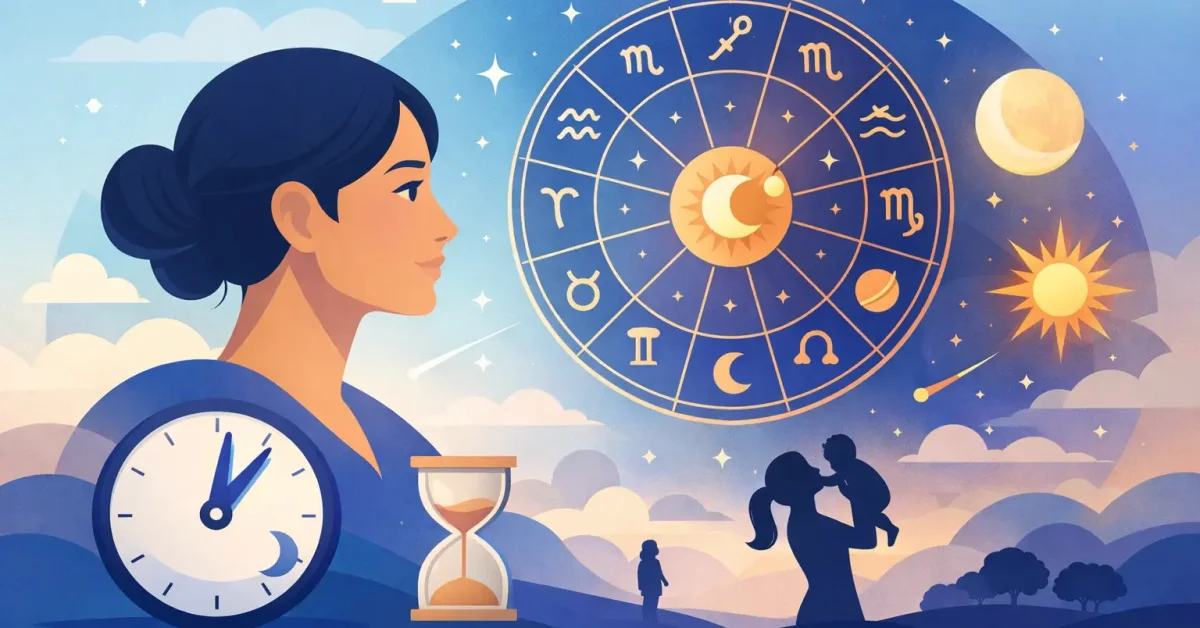
You can read your sun sign forecast in ten seconds and still feel like it missed the point. That gap is exactly why a personal horoscope by birth time matters. The moment you were born does more than place the Sun in a sign - it sets the angles of your chart, determines your rising sign, and maps the twelve houses that astrologers use to track where life is actually happening.
A generic horoscope speaks to millions of people at once. A birth-time-based horoscope narrows the focus. Instead of saying, "This week may bring changes," it can point to changes in partnership, money, home, career, or health because it knows which part of your chart current transits are activating. Your stars, decoded, becomes less of a slogan and more of a method.
What a personal horoscope by birth time actually uses
When people hear "birth chart," they often think of their sun sign plus maybe a moon sign. Useful, but incomplete. A personal horoscope by birth time is built from more precise chart architecture.
First, there is your rising sign, also called the ascendant. This changes roughly every two hours, which means two people born on the same day can have very different charts if their birth times differ. The rising sign sets the order of the houses, and the houses tell us which life areas are emphasized.
Then there are the chart angles - the ascendant, descendant, midheaven, and IC. These are sensitive points. When planets move across them, events and internal shifts often feel more visible. Career momentum can intensify around the midheaven. Relationship themes can sharpen around the descendant. Without your birth time, those timing cues are much harder to read.
A timed horoscope also uses planetary transits against your natal placements. That means it looks at where the planets are now and compares them to where they were when you were born. The result is not just personality analysis. It is an evolving interpretation of pressure points, opportunities, emotional weather, and timing.
Why birth time changes the reading so much
The clearest difference is house placement. Imagine Venus moving through your chart. If Venus is transiting your seventh house, the story may center on attraction, dating, partnership harmony, or negotiation. If the same Venus transit lands in your second house, the focus may shift to income, spending, self-worth, or what you value.
Same planet, same sign, very different life area.
This is where many people outgrow general horoscope content. Sun-sign astrology can describe the tone of a transit, but not always the location of its impact. Birth time adds that missing coordinate.
It also helps explain why a forecast resonates deeply for one Leo and barely at all for another. One may be experiencing a tenth-house activation tied to visibility and professional recognition. Another may be moving through a fourth-house chapter focused on family, roots, or private restructuring. Their sign is the same. Their lived astrology is not.
What you can learn from a personal horoscope by birth time
The value is not just more information. It is more relevant information.
In love, a timed horoscope can show whether relationship energy is moving through your seventh house of partnership, your fifth house of romance, or your eighth house of intimacy and trust. Those are not interchangeable themes. One points to meeting people and mutual attraction. Another can describe emotional entanglement, vulnerability, or shared resources.
In career, birth time helps isolate periods of visibility, redirection, workload pressure, and strategic growth. A Saturn transit to the midheaven can coincide with heavier responsibility or a reputation-defining phase. A Jupiter transit through the sixth house may bring improved workflow, better support, or a healthier daily rhythm before any public reward appears.
For emotional insight, timing matters just as much. A Moon-heavy transit may describe a temporary mood shift. A Pluto transit to your natal Moon can signal a much deeper process involving attachment, grief, family patterns, or psychological renewal. The chart distinguishes passing weather from climate.
That distinction is one reason personalized astrology feels useful rather than decorative. It frames your experience with more specificity, which often makes decision-making clearer.
What if you do not know your exact birth time?
This is where astrology becomes a matter of precision, not perfection. If you know your birth time from a birth certificate or family record, ideal. If you know only an approximate window, some forms of interpretation are still possible, but with limits.
Planetary sign placements usually stay intact across a full day, so your core natal chart may still be partly readable. The uncertainty affects house positions, rising sign, and timing-sensitive points most. If your birth time is off by even thirty to sixty minutes, house cusps can shift enough to change where transits are interpreted.
That does not make the chart useless. It just means the reading should be framed carefully. Broad personality insights may still hold. Timing around life areas becomes less reliable.
Some astrologers use chart rectification to estimate a birth time based on major life events. This can be insightful, but it is interpretive work, not an exact science. It is best approached with openness rather than false certainty.
How to tell if a birth-time-based horoscope is truly personalized
Not every "personalized" horoscope goes beyond surface level. Some tools simply attach your moon sign to a standard forecast and call it custom. A real chart-based interpretation should reflect several layers at once.
It should reference your natal chart structure, especially houses and major placements. It should consider current transits to your personal planets and angles. It should translate those transits into specific life areas instead of offering floating language that could apply to anyone.
The best versions also balance symbolism with practicality. They do not just say, "Mars energizes your chart." They tell you where that energy is showing up and what that may look like in ordinary life - sharper conversations, renewed motivation, conflict around boundaries, or a push to act on delayed plans.
That is the difference between astrology as atmosphere and astrology as guidance.
Personal horoscope by birth time versus sun-sign horoscopes
This is not a case of one being valid and the other being pointless. They serve different purposes.
A sun-sign horoscope is quick, accessible, and often useful for understanding the broad mood of a transit. It works well when you want a fast read on the week ahead. But it is naturally generalized.
A personal horoscope by birth time is better when you want context. It answers the questions that usually follow a vague forecast: Where is this happening? How personal is it? Is this about relationships, work, home, money, or identity? Is this a passing moment or part of a longer cycle?
If you are new to astrology, sun-sign content is often the entry point. If you want real chart-based clarity, birth time is what turns astrology from category-level content into something individually mapped.
When these readings are most helpful
Birth-time-based horoscopes are especially valuable during transitional periods. New relationships, breakups, career pivots, relocations, burnout, family changes, and identity shifts all tend to show up with clear chart signatures.
They are also helpful when nothing dramatic is happening but you feel a change under the surface. Sometimes a chart reveals that a quieter transit is asking for internal work before outer results appear. Not every important cycle arrives with fireworks. Some begin as a slow reorganization of values, habits, or emotional thresholds.
That kind of timing can be reassuring. It does not remove uncertainty, but it gives uncertainty shape.
For many people, that is the real appeal. Astrology does not need to predict every event to be useful. It can illuminate the quality of a period, the life area under pressure, and the kind of response that is likely to help.
A clearer way to use astrology
The most meaningful horoscopes are not the ones that sound mystical from a distance. They are the ones that meet your real life with enough detail to feel recognizable. A birth-time-based reading does exactly that by anchoring interpretation in your chart, your houses, and your timing.
If astrology has ever felt interesting but too broad, this is usually the missing piece. And if you already know your chart, a platform like Stellar Omens can make that precision easier to read day by day. The sky keeps moving. A personal map helps you notice where that movement matters most.
The best use of a horoscope is not to hand your choices over to it, but to let it sharpen your attention to what is asking for care right now.