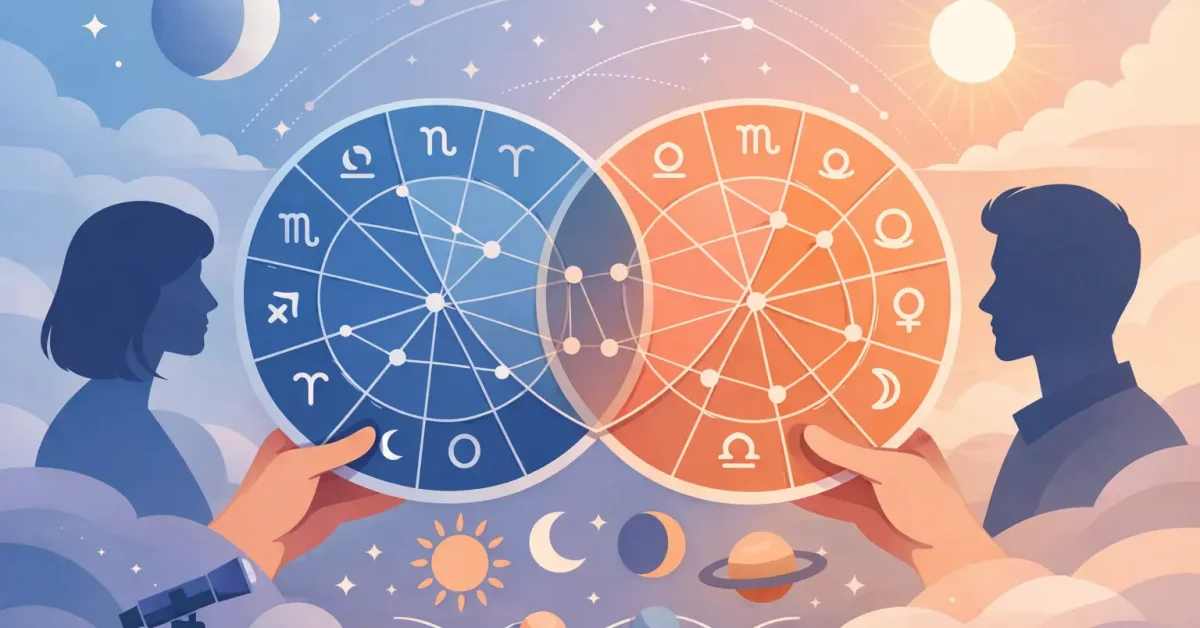
Some couples feel easy on day one and strangely difficult by month three. Others begin with friction, then build a bond that lasts. A synastry chart compatibility reading helps explain why by comparing two birth charts and showing how each person affects the other in real relationship terms.
This is where astrology becomes far more precise than simple sun-sign matching. Synastry looks at the full structure of connection - emotional habits, communication style, chemistry, conflict patterns, attachment needs, and the areas of life one person activates in the other. Instead of asking, “Are we compatible?” it asks a better question: “How do our energies actually work together?”
What a synastry chart compatibility reading really shows
At its core, synastry is the comparison of two natal charts. Each chart maps the sky at a person’s birth. When those two maps are placed together, the aspects between planets reveal attraction, tension, support, misunderstanding, obsession, and growth.
That matters because relationships are rarely defined by one feeling alone. You can have intense chemistry with weak emotional safety. You can have loyalty without enough spark. You can communicate beautifully while still triggering each other’s insecurities. A strong reading does not flatten all of that into “good” or “bad.” It shows where the relationship flows naturally and where it asks for maturity.
In practice, synastry examines how one person’s Sun, Moon, Mercury, Venus, Mars, and outer planets connect with the other person’s chart. It also looks at house overlays, which show where one partner lands in the other’s life experience. Someone’s Venus in your seventh house can feel very different from their Venus in your twelfth. Both may be meaningful, but the texture of the connection changes.
Why synastry is more useful than zodiac sign compatibility
Sun signs tell only a small part of the story. They describe core identity, but relationships live in many layers beyond identity alone.
The Moon speaks to emotional regulation, comfort, memory, and instinct. Mercury describes how you process, explain, and misunderstand. Venus shows affection, style of attachment, and what feels pleasing. Mars reveals desire, anger, pursuit, and sexual energy. Saturn often shows commitment, responsibility, and the lessons that make a bond durable or heavy.
That is why two people with “incompatible” sun signs may work beautifully, while a supposedly perfect zodiac match can feel exhausting. If one person’s Moon is deeply supported by the other’s Venus, there may be real softness and care. If Mercury and Mars are constantly clashing, the relationship may become reactive no matter how strong the attraction is.
A synastry reading respects that complexity. It does not reduce your connection to a memeable match score. It reads the architecture.
The most revealing parts of a synastry chart compatibility reading
Not every placement carries equal weight. Some contacts are immediately noticeable, while others emerge over time.
Moon aspects and emotional safety
If you want to understand whether a relationship feels emotionally nourishing, start with the Moon. Moon contacts often describe what happens when no one is performing. They show how each person reacts under stress, what comfort looks like, and whether vulnerability is welcomed or mishandled.
Moon-Venus aspects can create warmth and ease. Moon-Saturn can bring loyalty and stability, but sometimes emotional restraint. Moon-Mars may feel passionate and alive, though it can also turn minor disagreements into quick emotional flare-ups. None of these are automatic verdicts. They are patterns, and context matters.
Venus and Mars for attraction and chemistry
Venus and Mars speak loudly in romantic synastry. Venus reflects how you love and receive love. Mars shows how you pursue, assert, and desire. Harmonious aspects between them often create magnetic attraction and momentum.
But chemistry is not the same as compatibility. Strong Venus-Mars contact can keep a connection exciting while doing very little to improve communication or emotional steadiness. That is one reason some relationships feel impossible to leave even when they are difficult to sustain.
Mercury aspects and the quality of communication
Many people look for romantic spark first and communication second. In long-term relationships, that order often flips. Mercury contacts show whether two people can explain themselves clearly, listen generously, and repair conflict after the heat of the moment.
Easy Mercury aspects support mutual understanding. Hard Mercury contacts are not necessarily fatal, but they do suggest different rhythms of thought or speech. One person may want directness while the other needs time to process. One may speak from logic, the other from feeling. The issue is not who is right. The issue is whether the gap can be translated.
Saturn aspects and staying power
Saturn is often misunderstood. In synastry, it can feel binding, serious, protective, demanding, or karmic, depending on the chart. Strong Saturn contacts often show where responsibility and commitment enter the relationship. They can create longevity, but they can also bring pressure.
This is where nuance matters. A relationship without Saturn may feel easy but lack structure. A relationship with heavy Saturn may feel meaningful and enduring, yet emotionally weighty. For some couples, that depth supports real partnership. For others, it feels like hard work without enough relief.
House overlays and life-area activation
House overlays are one of the most practical features in a synastry reading because they show where the relationship lands in lived experience.
If someone’s planets fall in your fourth house, they may stir themes of home, family, and emotional roots. If they activate your tenth house, the connection may influence status, ambition, or public life. Seventh-house overlays often feel partnership-oriented. Eighth-house overlays can bring intimacy, entanglement, vulnerability, and power dynamics.
This is part of what makes astrology feel personal rather than generic. Two people can share similar aspects but experience the relationship very differently depending on which houses are involved.
What synastry can and cannot tell you
A synastry chart compatibility reading can show potential, friction, and recurring themes. It can reveal why one person feels stabilizing, why another feels intoxicating, or why a connection keeps circling the same unresolved issue. It can also validate something you already sense but have not been able to name.
What it cannot do is replace choice. No chart makes communication unnecessary. No difficult aspect guarantees heartbreak. No beautiful aspect guarantees emotional maturity.
Astrology describes patterns, not fixed outcomes. Two people with challenging synastry may build a remarkable relationship if they have self-awareness, timing, and mutual effort. Two people with easy aspects may still drift apart if the bond lacks depth or intention. A reading is most useful when it is treated as insight, not destiny.
When to get a synastry reading
Some people seek synastry at the beginning of a relationship, when everything feels charged and uncertain. Others look at it after confusion sets in and they want clarity on what is actually happening between them.
Both are valid, but the purpose shifts. Early on, the reading can help you see whether attraction is supported by emotional and mental compatibility. Later, it can explain repeating dynamics and identify what the relationship is asking from both people.
It can also be valuable outside romance. Synastry works for friendships, family ties, creative partnerships, and work relationships. Not every meaningful bond is romantic, and astrology is often at its most helpful when it clarifies the relationships that shape daily life.
How to read the results wisely
A good synastry reading is interpretive, not alarmist. It should help you understand the connection without reducing either person to a problem. Watch for language that treats one difficult aspect as a final answer. Real relationships are layered.
It also helps to consider timing. If the synastry is strong but the current transits are intense, the relationship may feel more unstable than it is at baseline. If the synastry is challenging but both people are in a grounded season of life, the bond may function better than expected. Precision comes from context.
That is part of the value of a chart-based platform like Stellar Omens. When relationship astrology is read with structure and clarity, it becomes less about fantasy and more about useful emotional intelligence.
The best reason to seek a synastry reading is not to prove that a relationship is perfect. It is to understand the shape of the connection you are actually in. Sometimes that brings reassurance. Sometimes it brings a necessary reality check. Either way, clarity is its own kind of compatibility.