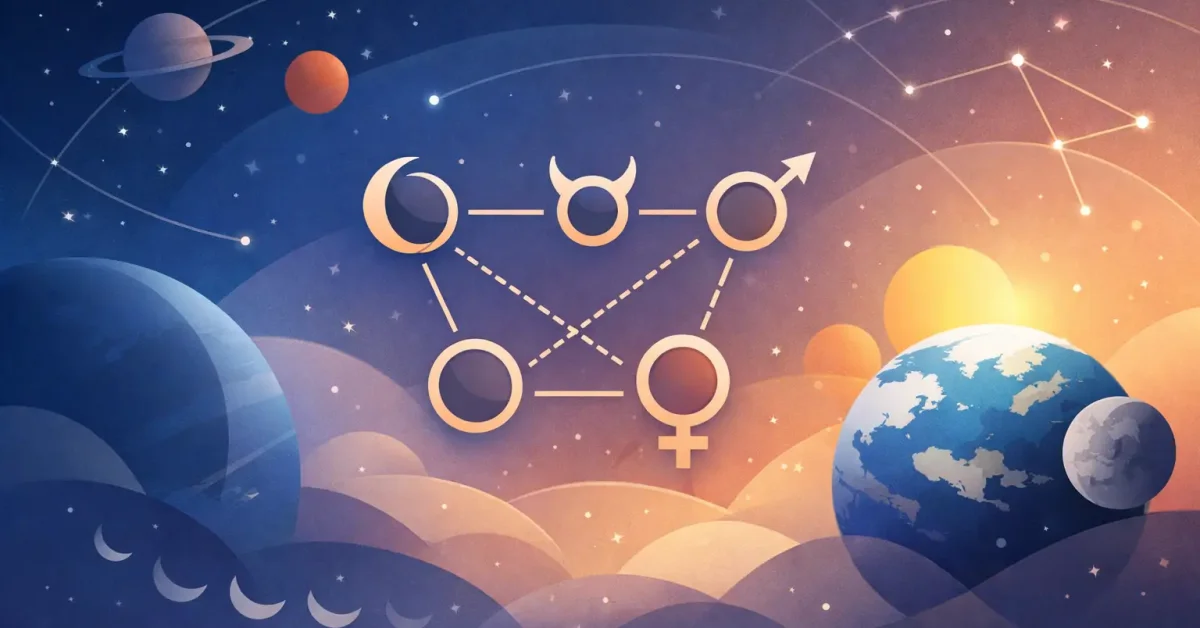
If you have ever looked at a birth chart and felt your eyes catch on all those intersecting lines, you were already looking at one of astrology’s most revealing layers. Planetary aspects meaning in astrology comes down to relationship: how the planets speak to each other, where the tension lives, where the ease flows, and where your chart gains its particular rhythm.
Signs describe style. Houses show life areas. Planets name the core functions of the psyche. Aspects tell you how those functions interact. That is why two people with the same Sun sign can move through love, work, stress, and ambition in completely different ways. The geometry between planets changes the entire tone.
What planetary aspects meaning in astrology really refers to
An aspect is the angular distance between two planets or points in a chart. When astrologers say Venus is square Saturn, or the Moon is trine Jupiter, they are describing a specific relationship based on degrees. That relationship suggests how those two parts of life and personality cooperate, compete, amplify, or complicate each other.
Think of aspects as the dialogue inside the chart. Mercury may want to think quickly and rationally, while Neptune blurs edges and brings intuition, imagination, and sometimes confusion. If those two planets are in a flowing aspect, the result might be poetic speech or strong symbolic thinking. In a hard aspect, the same combination can show mental fog, mixed signals, or a tendency to idealize facts.
This is where astrology becomes less generic and far more personal. An aspect does not just say what energy exists. It says how that energy behaves under pressure, in connection, and over time.
The major aspects and how they work
Not all aspects carry the same weight. Some are central to interpretation because they create the strongest patterning in a natal chart or transit.
Conjunction
A conjunction happens when two planets are close together, usually in the same sign or within a tight degree range. This is a merging aspect. The two planetary energies blend, and sometimes they become difficult to separate.
That can be powerful, but it depends on the planets involved. Sun conjunct Mercury can make someone mentally expressive and self-defining through ideas. Mars conjunct Saturn can produce discipline and endurance, but also frustration or stop-start energy. Conjunctions intensify whatever they touch. They do not guarantee harmony.
Sextile
A sextile is typically seen as supportive. It creates opportunity, movement, and cooperation between planets, often with a subtle, productive quality. Sextiles are helpful, but they usually need engagement. They are less automatic than trines.
For example, Venus sextile Mars can support confidence in attraction and creativity. Mercury sextile Jupiter often favors learning, perspective, and communication. The gift is there, but it tends to respond best when used deliberately.
Square
Squares are friction aspects. They create internal conflict, pressure, and the need for adjustment. In practical terms, squares often show where life demands growth through tension.
A Moon square Saturn aspect can reflect emotional reserve, self-protection, or difficulty trusting support. But it can also build resilience and maturity over time. A square is rarely comfortable, yet it is often motivating. In many charts, the square is what pushes a person to evolve rather than stay in habit.
Trine
Trines are flowing aspects. They suggest ease, talent, and natural compatibility between planets in the same element. Fire trines energize. Water trines deepen feeling. Earth trines stabilize. Air trines connect ideas and social intelligence.
The trade-off is that trines can become so natural they go unexamined. A person with Mercury trine Uranus may have original, quick insight, but may not realize how distinctive that gift is because it feels effortless. Trines help, but they do not always push action the way squares do.
Opposition
An opposition places two planets across from each other. This creates polarity, awareness, and a need for balance. Oppositions often show up through relationships, projection, and outer circumstances.
Venus opposite Pluto may bring intensity in love, magnetism, and deep attachment patterns, but also issues around power, control, or fear of loss. The lesson of the opposition is not choosing one planet over the other. It is learning how to hold both ends without collapsing into extremes.
Why aspects matter more than isolated placements
A single placement can only tell you so much. Venus in Libra describes a relational style. But Venus square Uranus tells you that love may also involve unpredictability, restlessness, or a strong need for freedom. Venus trine Saturn tells a different story - one of steadiness, loyalty, and long-term values.
This is why real chart interpretation depends on context. A person may have a gentle Moon sign but a Mars square Moon aspect that makes feelings fast, reactive, or sharp-edged under stress. Another may have a bold Aries Sun softened by Neptune aspects that add sensitivity, idealism, or uncertainty.
Aspects give shape to contradiction, and contradiction is part of what makes a chart human.
Planetary aspects meaning in astrology for everyday life
For most people, aspects become most useful when they are translated into real situations. The chart is not abstract. It is lived.
In relationships
Aspects often describe attachment patterns, communication style, and attraction dynamics. Venus and Mars aspects can show chemistry and desire. Moon aspects reveal emotional needs and instincts. Mercury aspects shape how conflict gets discussed or avoided.
A person with Moon trine Venus may naturally create warmth and emotional ease in partnership. Someone with Mercury square Mars may speak directly, argue quickly, or feel mentally activated by disagreement. Neither is better. Each needs a different kind of awareness.
In career and ambition
Sun, Saturn, Mars, Jupiter, and Mercury aspects often stand out in professional life. A Mars trine Saturn aspect can support strategic effort and endurance. Sun square Jupiter may bring confidence and vision, but also overextension. Mercury conjunct Pluto can indicate deep focus, investigative thinking, or persuasive communication.
The point is not to label an aspect as lucky or difficult. It is to understand the working style behind it.
In timing and transits
Natal aspects show your baseline wiring. Transiting aspects show when certain themes are activated. If transiting Saturn squares your natal Moon, emotional pressure may rise. Boundaries, responsibility, or fatigue may become central themes. If transiting Jupiter trines your natal Sun, confidence, expansion, or visible opportunity may increase.
Timing matters because an aspect is not only a personality statement. It can also describe a season. The same chart can feel very different under different transits.
Hard aspects are not bad, and easy aspects are not always easy
This is one of astrology’s most important corrections. People often assume squares and oppositions are negative while trines and sextiles are positive. The truth is more nuanced.
Hard aspects create strain, but they also generate movement. Many highly accomplished people have strong squares because pressure taught them how to build skill, discipline, or self-definition. Easy aspects can bring real gifts, but if everything comes naturally, development can become passive.
It depends on the chart, the planets involved, the condition of those planets, and how consciously the person is living the pattern. Astrology describes energy. It does not remove agency.
How to read aspects without getting lost
Start with the closest aspects first. Tighter degree connections usually speak louder. Then look at the planets involved. Ask what each planet represents, and what kind of relationship the aspect creates.
After that, place the aspect in context. Which houses are involved? Does the aspect repeat a larger theme in the chart? Is it supported or challenged by other placements? One square alone means less than a square that echoes through several chart layers.
This is also why personalized interpretation matters. Reading one aspect in isolation can be interesting, but the real meaning appears when the whole chart is considered together. At Stellar Omens, that chart-based precision is what turns symbols into guidance you can actually use.
The deeper value of aspects
Planetary aspects show where life feels fluid and where it asks more from you. They reveal your inner negotiations: head versus heart, freedom versus commitment, speed versus stability, desire versus caution. They also explain why certain themes keep returning until they are understood more clearly.
Once you begin reading aspects well, astrology becomes less about labels and more about pattern recognition. You stop asking, What sign am I supposed to act like? You start asking, How does my chart process love, stress, ambition, timing, and change?
That is a much more useful question. And usually, a much more honest one.
The chart does not ask you to become someone else. It asks you to understand the conversation already happening within you - and to work with it more consciously.