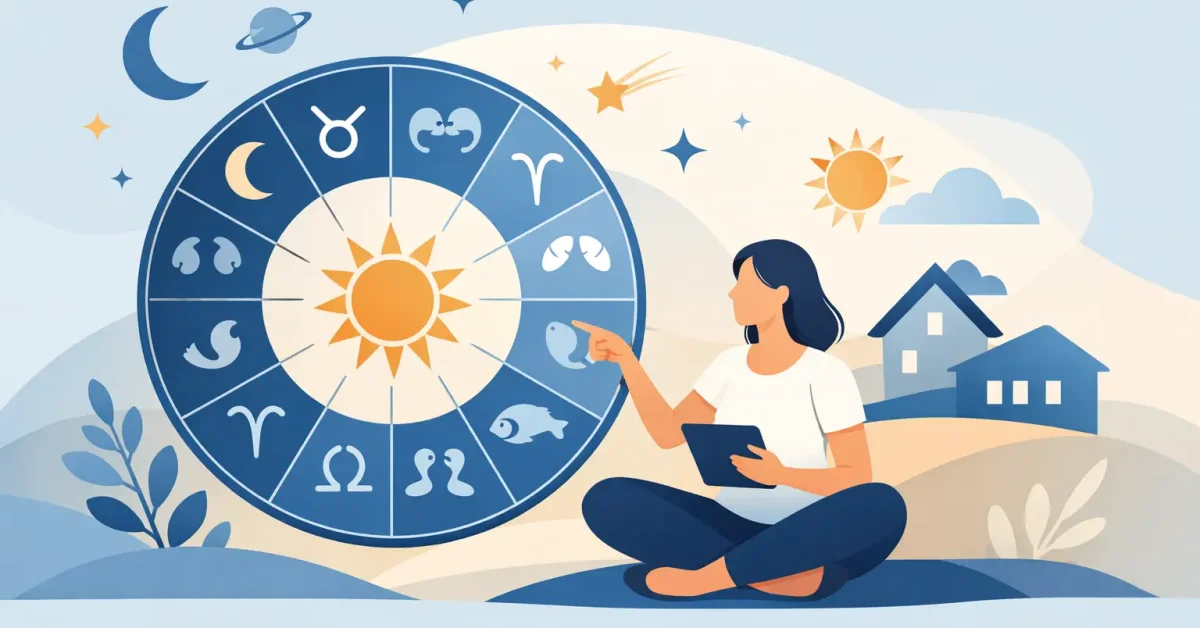
If you have ever looked at a birth chart and thought, I understand the zodiac signs, but what are all these sections, you are asking the right question. Astrology houses explained simply means this: signs describe how energy moves, planets show what is happening, and houses reveal where in life that energy lands.
That “where” changes everything. A Venus placement can speak about love, beauty, and connection, but the house tells you whether that Venus expresses itself most strongly through romance, career visibility, friendships, or private healing. Houses are what make astrology personal, specific, and surprisingly practical.
Astrology houses explained simply: what houses actually do
Think of the 12 houses as 12 life areas. They divide the birth chart into distinct zones, each linked to a different part of human experience. One house speaks to money, another to relationships, another to career, another to the inner world, and so on.
This is why two people with the same sun sign can live that energy very differently. A Leo Sun in the 10th house may feel most alive through leadership, ambition, and public recognition. A Leo Sun in the 4th house may express that same warmth and pride through family, home, and emotional roots. Same sign, different stage.
In a natal chart, the houses are set by your exact birth time and location. That is a key detail. Signs move more slowly, but the houses shift quickly throughout the day, which is why birth time matters so much in chart interpretation. If the signs are the style and the planets are the actors, the houses are the rooms where the story unfolds.
The 12 astrology houses, in plain language
Each house carries a traditional meaning, but the best way to understand them is through real life.
1st House - self and identity
The 1st house is your entry point into the chart. It describes your presence, your instinctive style, your physical expression, and how you meet life. This is the house of first impressions, but also of raw identity. It often shows how you move before you have time to overthink.
2nd House - money, values, and stability
The 2nd house covers income, possessions, self-worth, and what helps you feel secure. It is not just about how much money you make. It also reflects what you value, what you are building, and how you define enough.
3rd House - communication and everyday thinking
This house rules learning, speaking, writing, local environments, siblings, and your mental habits. It is your day-to-day mind. If the 9th house is big-picture wisdom, the 3rd is the immediate exchange of ideas.
4th House - home, roots, and inner foundations
The 4th house speaks to family, ancestry, private life, emotional grounding, and the space you return to when the world gets loud. It can describe literal home life, but also your deeper sense of belonging.
5th House - romance, creativity, and joy
This is the house of pleasure, self-expression, dating, art, play, and children. It shows where you create for the sake of being alive, not just for productivity. The 5th house has sparkle, but it also reveals how comfortable you are being seen.
6th House - work, health, and routines
The 6th house rules habits, responsibilities, wellness, service, and the systems that keep life functioning. It often gets simplified as “work,” but it is more precise than career status. It is the rhythm of your daily effort.
7th House - partnerships and commitment
The 7th house governs one-to-one relationships, including romance, business partnerships, contracts, and the kinds of people you attract. It shows what you seek in balance and what relationship teaches you about yourself.
8th House - intimacy, transformation, and shared resources
This is one of the more layered houses. It relates to emotional merging, trust, debts, taxes, inheritance, power dynamics, and deep psychological change. The 8th house is rarely light, but it is often where profound healing begins.
9th House - meaning, belief, and expansion
The 9th house covers higher learning, travel, philosophy, spirituality, and worldview. It reflects the search for perspective. When this house is active, life often asks you to widen your lens.
10th House - career, reputation, and public life
The 10th house is the most visible point of the chart. It speaks to vocation, achievement, ambition, leadership, and the legacy you are building. This is less about your job title on a random Tuesday and more about the path you want to be known for.
11th House - friendship, community, and future goals
This house rules social networks, collaborators, group belonging, and long-range hopes. It shows how you participate in something larger than yourself and what kind of collective vision pulls you forward.
12th House - rest, endings, and the unseen
The 12th house governs solitude, dreams, the subconscious, spiritual retreat, hidden patterns, and closure. It can feel mysterious because it deals with what is not fully visible yet. But it is also where insight grows quietly before it becomes clear.
Why houses matter more than many beginners realize
A lot of people begin astrology with their sun, moon, and rising signs. That makes sense. Those placements are foundational. But houses are where the chart starts to sound like your life instead of a generic personality profile.
For example, Mars in astrology describes drive, conflict, and action. Put Mars in the 3rd house, and it may show up in sharp communication, fast thinking, or a tendency to debate. Put Mars in the 6th, and it may push toward disciplined routines, high productivity, or stress that lands in the body. Put Mars in the 12th, and the energy may be less obvious, more internalized, or harder to access directly.
The planet is still Mars. The house changes the setting.
This is also why transits make more sense when you know your houses. If Saturn is moving through your 7th house, relationships may feel serious, defining, or tested. If Jupiter is moving through your 2nd, money, confidence, or values may expand. The planet shows the type of energy. The house tells you which part of life is being activated.
How to read houses without overcomplicating them
The cleanest way to interpret a house is to use a simple three-part structure. First, identify the house. Second, note the sign on that house cusp. Third, look at any planets placed inside it.
Say your 10th house begins in Taurus. That can suggest a steady, value-driven, materially aware approach to career or public reputation. If Venus is also in the 10th house, that theme becomes stronger, adding charm, aesthetics, diplomacy, or relational intelligence to how you are perceived.
If a house is empty, it does not mean that area of life is missing. It just means the house is not being emphasized by a natal planet. You still read the sign on the cusp and the condition of its ruling planet. Empty houses are normal.
It also helps to avoid treating houses as fixed fates. A strong 8th house does not doom you to crisis. A loaded 10th house does not guarantee fame. Astrology shows patterns, pressures, and potentials. Life still has nuance, timing, and choice.
Astrology houses explained simply for everyday use
The most useful way to work with houses is to connect them to the questions you are actually asking.
If you want insight into dating, look at the 5th and 7th houses. If you are thinking about career direction, start with the 10th, then check the 6th for work habits and the 2nd for income. If you feel emotionally unsteady, the 4th house can reveal what grounding really means for you. If a season of life feels hazy or inward, the 12th house may be active, asking for rest instead of constant output.
This is where astrology becomes less decorative and more useful. Houses translate symbolism into life areas you can recognize. They help answer not just who you are, but where your growth, tension, and opportunity are showing up right now.
For anyone using chart-based tools, this is often the shift that makes astrology click. General horoscopes can be interesting, but once houses enter the picture, interpretation becomes more precise. That is part of what makes a personalized reading on a platform like Stellar Omens feel more grounded in real experience.
One final way to think about the houses
If signs are the atmosphere and planets are the moving parts, houses are the lived terrain. They show where love asks for attention, where ambition gets tested, where healing takes time, and where life keeps inviting you to become more fully yourself. Learn the houses slowly, and your chart begins to read less like a code and more like a map.